The Favor that Became a Template
A friend called a few weeks back asking for advice. She’s a director at a small, family-owned company. She’s technically the head of product, but because of the company’s size, she has her hands in everything. One day she’s on a sales call, the next she’s working with the marketing team, and the day after that she’s with the CEO and other department heads determining when their next product release should ship.
During one of these meetings, after she and a couple of team members had spent an hour looking at schedules that didn’t make sense, the CEO asked her to take ownership of the project management team: one junior PM and one senior PM. Both PMs, who had been reporting directly to the CEO, kept their projects moving, but neither, however, had what she described as true project management experience. And now she was being asked not just to manage them, but to stand up a PMO.
My friend had been in and around project management her entire career, but she didn’t come from a project management background. When I asked what she was looking for, she laughed.
“I’m not really sure. That’s why I’m talking to you.”
So I built her something to start from.
What I Built
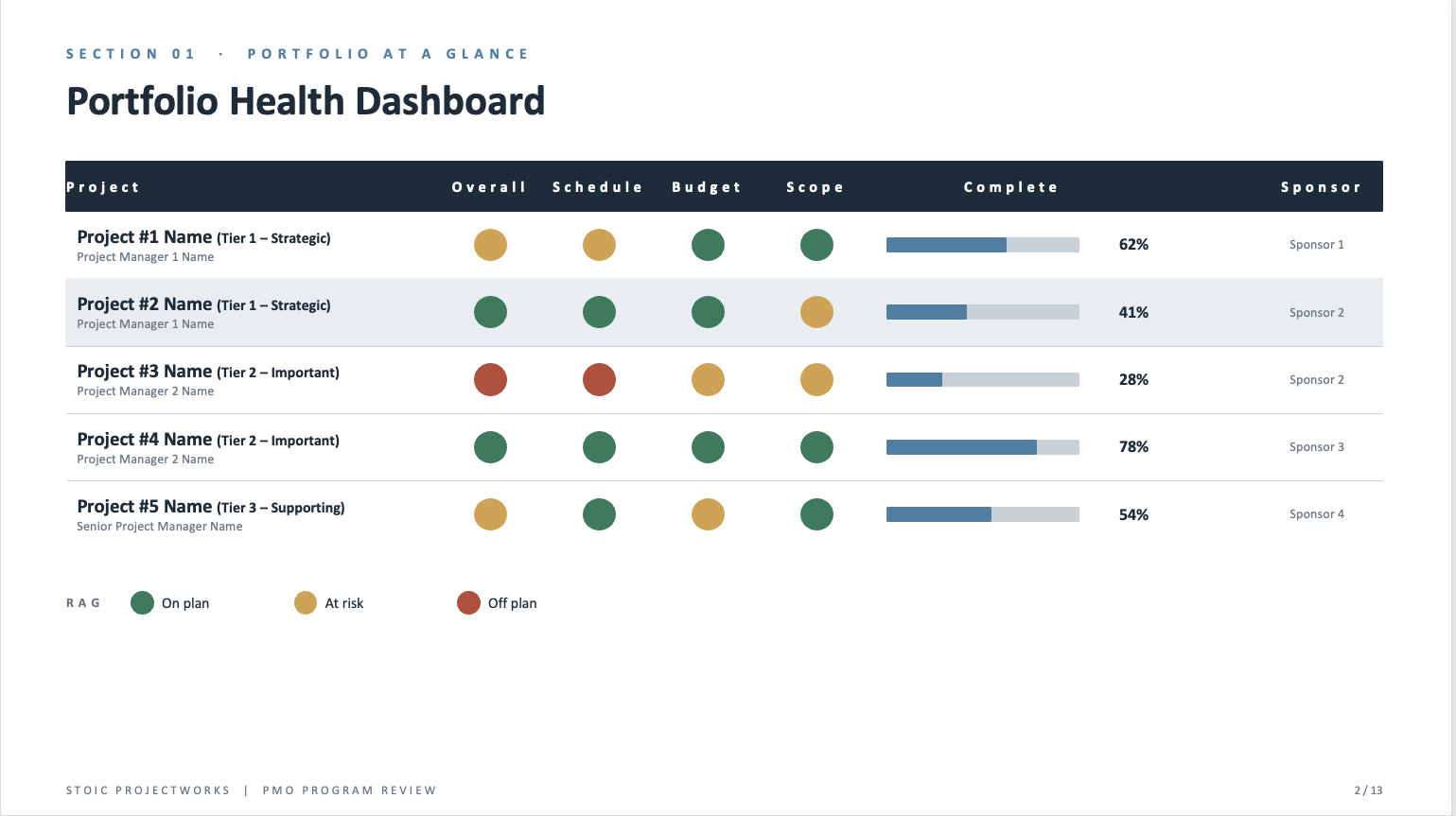
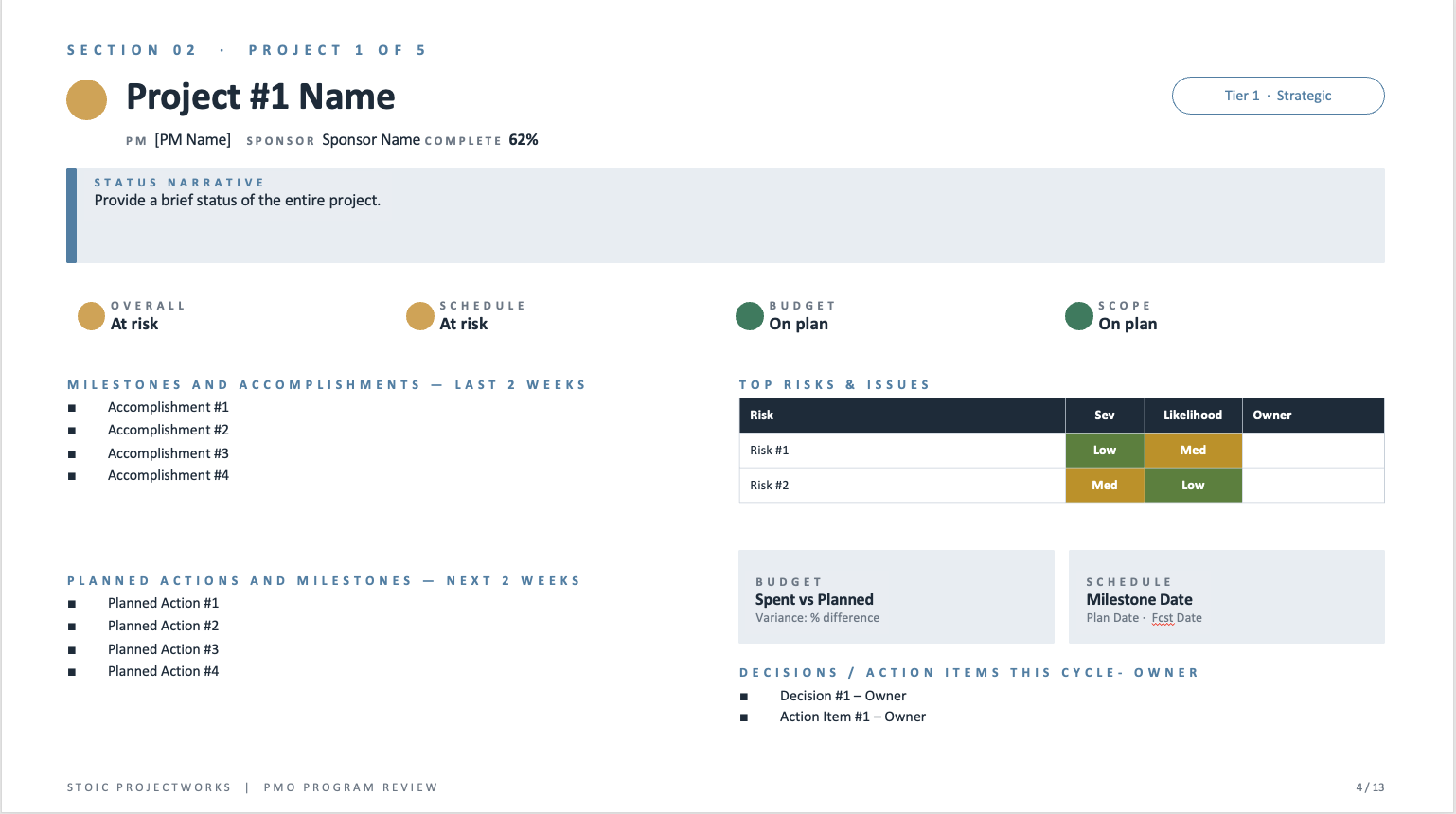
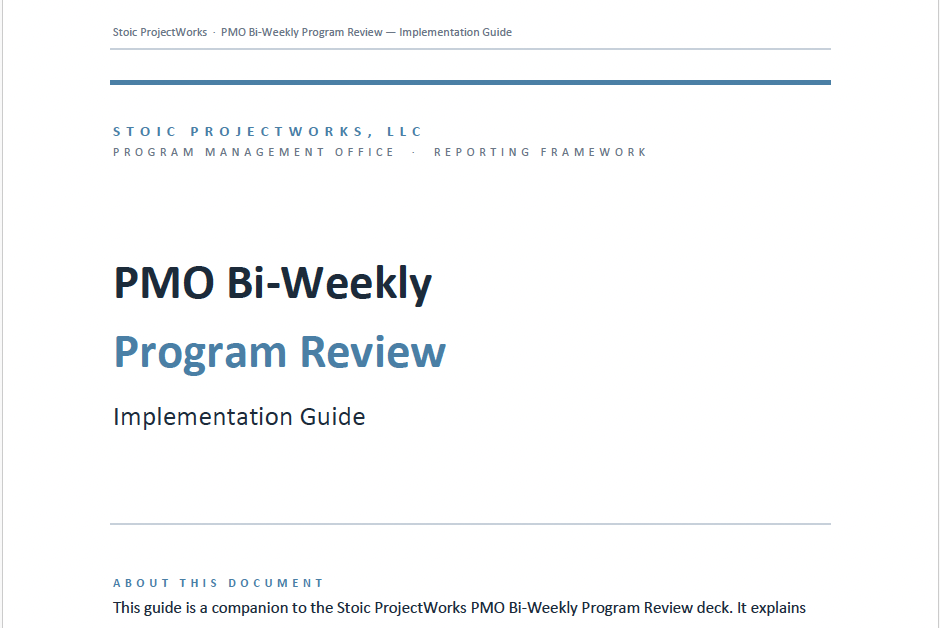
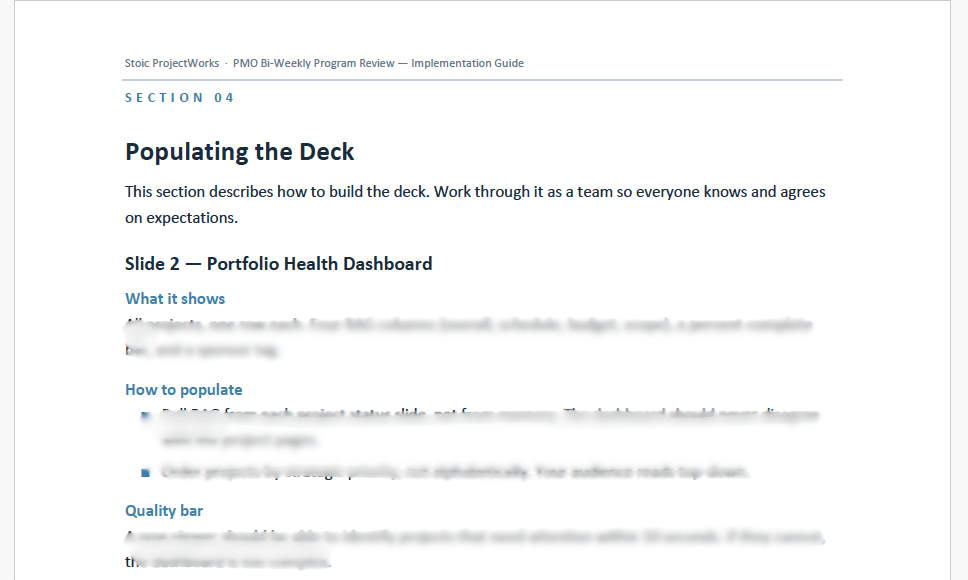
The deliverable was a 13-slide PowerPoint deck for a bi-weekly program review, plus a 15-page implementation guide. The deck covers a portfolio health dashboard, portfolio-level KPIs and trends, a project status template repeated five times (one per project), resource capacity, decisions made, action items, and a 60-day milestone look-ahead. The guide explains how to populate every slide, defines RAG criteria, suggests a meeting agenda, and walks through how the framework could evolve as the portfolio matures.
A few design decisions worth calling out:
The portfolio dashboard had to work as a standalone slide. The people in a program review don’t want their time wasted. They’ll look at one slide more than any other, the dashboard showing overall health: four RAG (Red-Yellow-Green) dimensions per project, a completion bar, and a sponsor tag. Anyone in the room should be able to identify projects that need attention in 10 seconds.
Project status slides got a fixed template. Consistency is key. When every project reports the same information in the same place, the audience learns where to look and the meeting moves fast.
The decisions slide is non-negotiable. I’ve been in rooms where a decision gets made and, five minutes later, it’s already forgotten. If a program capture what was decided and who owns what next, you might as well treat those decisions as having never been made.
The implementation guide is just as important, if not more important, than the deck itself. The deck is great, but if you don’t know how to use it, how to populate it, it’s worthless. The real value is found in the implementation guide.
Maybe This Sounds Familiar
If you’re reading this, there’s a decent chance you’re somewhere in my friend’s story. Maybe you’ve just been handed a portfolio you didn’t ask for. Maybe you’ve got capable people keeping projects moving but no shared way to see how the whole thing is doing. Maybe your leadership team wants “real” status reporting, and you’re not sure what that should even look like.
That’s the work I do. I can help you stand up a PMO, bring order to portfolios, and build the cadences and artifacts that keep complex work visible and moving. Sometimes that’s a full engagement. Other times it’s going to be a couple of conversations and a template that gets a team unstuck. Either way, the goal is the same: To leave you with something that works the day I hand it over and keeps working long after.
Take the Template
Here’s the thing I’m genuinely excited about: When I built this for my friend, I kept a generalized version specifically so I could share it. So that’s what I’m doing.
If you’d like the deck and the implementation guide as a starting point, send me a message and I’ll email them to you directly.
Take them, adapt them, and make them yours. There’s nothing prescriptive about anything I’ve built; all of it is meant to be tailored to your environment. The framework holds whether you’re running three projects or thirty, waterfall or agile or some blend of the two.
And if you’d rather not start from a blank template, if you want help shaping it around your portfolio or building the rest of the operating model around it, let me know. That’s exactly the kind of conversation I like to have.
The Footnote
My friend ran her first bi-weekly meeting with the new deck a couple of weeks ago. The CEO congratulated her on a job well done and thanked her for taking the PM team on. Afterward, she sent me a thank-you note.
I sent her one back.
Will Welsh is the founder of Stoic ProjectWorks, LLC, a consulting practice focused on project management and editorial services. He helps organizations stand up PMOs, run programs, and build structured reporting systems that hold complex work together.
